


The full picture of content marketing in customer and business context with tons of resources to make you and your audiences succeed.
Content marketing is an umbrella term covering a set of strategies, techniques and tactics to fulfill business and customer goals by using the most relevant content to serve, attract, convert, retain and engage customers in a trustworthy and valuable way.

It is used across the customer journey and customer life cycle but doesn’t start nor end with the customer in the strict sense. Internal customers are crucial in an integrated approach as well. Content marketing further serves several business functions in a consistent, integrated and continuous way. It looks at the customer from a connected and customer-centric perspective and takes into account the content requirements of anyone serving and engaging prospects and customers.
One of the goals of content marketing is to optimize business value and audience/customer value by providing and leveraging the right content across the right channels in the most timely, valuable, connected, personalized and optimized way across and beyond the customer/audience life cycle.
This online guide provides an overview of what content marketing is, where it comes from, why it matters, how to get started and resources to succeed.
Content marketing: what is it?
Content marketing is a marketing technique, covering a broad range of tactics and processes, whereby
- content and information needs/preferences of strategically defined target audiences are analyzed,
- content is created to serve these needs in alignment with predefined marketing goals,
- the created content is made available, optimized and used to serve customers and business objectives in all possible areas of marketing, PR, sales (enablement) etc. in a measured and integrated way.
Content marketing isn’t new. We’ ve been practicing it since far longer than the term existed, as did many others. Research shows that the majority of organizations use content marketing, in the sense of using content for any possible marketing or customer-facing role, regardless of content format, medium or channel.
Content marketing creates value where the goals/intent and preferences of audiences meet the narrative, proposition and relevance of your content.
What is “new” with content marketing, though, is the way of looking at the role of content in a more strategic, planned, integrated, intelligent and customer-centric way, de facto requiring a content marketing strategy.
Content revolves around emotions and experiences: brand experiences, user experiences, the customer experience, all highly emotional in nature, even when ‘a piece’ of content is “just” an informative answer to a question.
Content is the glue and trigger of interaction in a customer-centric marketing view with relevance, consistency and mutual/connected value for audiences and brand at the center. By offering value to pre-defined groups of people content creates value for the customer in the broadest sense, in tune with brand and business objectives, and leading to value for the organization.
Content marketing further has ties with content management and information management, as well as various marketing platforms, as systems of engagement and intelligence, helping to gain insights on audiences and to achieve a streamlined right time and right place approach, leveraging various channels and information sources which often reside in silos.
The value of content marketing for the organization ultimately always gets translated into an impact on overall marketing ROI. The value and relevance of content lies in the eyes of the audiences and individual ‘consumer’ and can range from an entertaining value to a valuable answer to a question or a valuable experience of any other nature. Finally, content is essential in conversion optimization.
Rather than focus on the label, it’s important to focus on the underlying reality that consumers and prospective buyers are more empowered and that the use of content for marketing purposes requires a strategic approach.
The many definitions of content marketing
There are many definitions regarding content marketing. However, these definitions and the term as such become meaningless, even if we will hear it for many years to come, until it might eventually disappear as content marketing becomes mainstream.
The practices and principles of ‘good’ content marketing, however, are here to stay, regardless of the definitions and even as content marketing – rightfully and obviously – continues to already be part of good, integrated and customer-centric marketing. We like the no-nonsense way in which expert Doug Kessler looks at the term, as you can see in the quote.
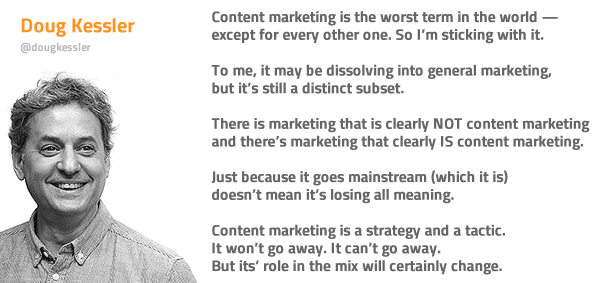
Instead of “selling” the concept of content marketing and debating about what it exactly means and includes, it’s best to have a no-nonsense approach, looking at the broader context of the use of valuable content in a systematic, relevant, engaging and continuous way.
Content marketing in business and customer context, focused on offering value through great customer experience, brand experiences, etc.
Content that actually helps, makes a brand statement and leads to tangible results across the customer life cycle.
Although content marketing is not just about digital marketing, the digital dimension plays an increasing role (even if the lines between digital and physical don’t exist for a channel-agnostic consumer).
In recent years and due to the success of the term and the growing awareness of marketers that relevant content is necessary and undervalued, the term content marketing is used for many purposes and tactics in the digital and social marketing context, ranging from social content and search engine optimization to even online advertising (so-called ‘native advertising’).
More about the definition of content marketingWhat marketing goals can content marketing serve?
Given the fact that content plays a role in virtually all marketing techniques and tactics, there are no goals that can’t be reached using content.
The marketing goals that are typically mentioned across a myriad of research reports differ somewhat between B2B and B2C content marketing and also depend on contextual factors such as the geography, type of business, audiences etc.
The question should not be what marketing goals you can realize using content (marketing). Given the importance of content but also of relevant and timely information in ALL business areas today, the question is ‘how will I leverage content and information as part of my efforts to realize such and such goal?’.

However, in practice we see that marketers focus on some key goals such as:
- Brand awareness.
- Lead generation.
- Engagement.
- Sales.
- Lead nurturing.
- Customer retention and loyalty.
- Customer evangelism.
- Up-selling and cross-selling.
- Partner enablement.
- Channel marketing.
- Customer experience enhancement.
- Conversion optimization.
Although these are the typical goals found in research, we invite you to think out of the box and also look at the goals of your “audiences’.
More about marketing goals and content marketingContent marketing strategy: making a plan
If you’re a small local retailer in bathroom equiment, you may limit yourself to making sure you can answer the questions of your customers and keep them loyal or make them buy more or have more people buy from you (word-of-mouth indeed). But, then again, maybe that local retailer wants to grow and decides to use content for it, which is perfectly possible (no boring or small businesses when it boils down to the possibilities of creating relevant content).
However, an integrated approach for an internationally active, mature company, with a complex sales cycle / buying cycle, different go-to-market paths, multiple locations, different languages and multiple goals will typically have a somewhat more “complex” content marketing strategy.
If you’re new to content marketing strategy, check out “Content marketing strategy in plain English: getting started“. If you know what a content marketing strategy typically is about, click below for a more advanced overview on how to define and deploy a content marketing strategy.

Organizing and managing content marketing
Content marketing requires a strategy or plan. But it also requires some planning, resources, processes and of course also people.

How do you organize it internally? What teams are involved? External contributors? Do you need someone to manage it? What are the roles and responsibilities? Who keeps the overview?
These are all essential questions, especially as content marketing is not an island but it does have some very specific processes that need to be managed and orchestrated in a collaborative way.
Organizing and managing content marketingGetting content marketing done: roadmaps and steps towards success

Content marketing success depends on the outcomes you strive for.
Usually, they are a mix of mid-term and long-term goals as content marketing is not for the short run (only). However, there is quite some low-hanging fruit, enabling you to get results fast.
Content marketing success in 7 steps
Dave Chaffey of Smart Insights collaborated with HubSpot and several content marketers, including us, to make an infographic and paper, based on the strategic framework and research of Dave Chaffey. In a step-by-step article we introduce you to different success parameters of content marketing with additional tips, quotes from the participants, the infographic and much more. A great place, providing all you need to go from plan to execution and optimiziation. It also contains a framework for content planning. Check it out via the button below.
Creating a content culture: identifying, capturing, managing and governing

When you start using content marketing in a strategic and systematic way, you need to get several people on board, including various employees. Furthermore, organizations often have lots of content sitting in siloed systems and in the heads of their employees.
And, without realizing it, we are creating content the whole time.
Examples of content ‘capturing’ opportunities you might overlook
When product marketing or R&D are briefing other teams in meetings in calls they are essentially providing a narrative of why specific products or solutions are being launched or offered.
And these reasons are always about a market need. So, when this need is explained internally, it’s a great idea to “capture” what is being said in those meetings that are often about topics that are close to the customer. Read more about the role of product marketing in “Content marketing in the real world: the role of product marketing“.
When you organize an event or participate in a tradeshow you can have speakers (internal, external), you see customers and prospects, you might have partners at your event who are close to their customers, etc.
All the interactions at an event offer ample opportunities to not just identify (content) needs but also to “capture” content. Obviously, events can also be boosted and the ROI can be optimized when doing pre-event interviews or content creation, on the spot social content activities and post-event marketing.
The link with content management
A mentality of “capturing” content in a systematic way is part of creating a content marketing culture, aligned with a customer-centric culture. But capturing (audio recordings, video, even social content) is not enough.
You also need to “translate” captured content into content that’s appreciated by your audiences. And, last but not least, you need a way to manage the content you have and unlock it by making the link between content management and information management on one hand (typically not the role of marketing) and your content marketing team on the other.
It’s one of the areas where IT and business meet. A content culture is not just about marketing, it’s also about knowing where content sits, governance, collaboration, etc.
Storytelling, content marketing and sharing
Storytelling is probably one of the most heard terms in a content marketing context.

It goes hand in hand with content sharing, social content marketing, social media, copywriting, visual content, you name it. Storytelling is also closely related with word-of-mouth, recommendations and the simple act of sharing and connecting, since long before digital marketing, let alone content marketing even existed. We know why: storytelling is one of the most human ways of passing along knowledge and traditions, mesmerizing audiences and, in fact, human nature as such. What does storytelling mean in a content marketing context? Below are a few resources on storytelling and content marketing.
Content sharing and storytelling: why and how people share content
Content sharing, word-of-mouth and storytelling are closely related.
What makes people share content and stories? From the psychology of sharing to content sharing practices, expert views and storytelling: this article, with plenty of visuals and additional resources, tells it all. Check it out.
The art of storytelling in 6 content marketing questions
The previous article primarily focused on content and story sharing.
We also have one which provides an exhaustive and visually rich overview of storytelling in general, storytelling in content marketing and of course again more resources. Check it out.
Digital storytelling: when art and science connect emotions
In a digital age new techniques are used to leverage digital content and storytelling for digital content marketing.
Obviously, the rules of storytelling in general also apply to the digital world. However, with the advent of for instance big data we see phenomena such as data storytelling and several forms of storytelling which are fed by digital resources or leverage digital formats to appeal to an increasingly ‘digital customer’. Click to learn more.

Content marketing experts on storytelling
The above mentioned sources contain some thoughts and considerations regarding storytelling from several content marketing experts and of course from great storytellers.
You also might want to check out what some of them have been saying regarding storytelling on our site.
Robert Rose on content marketing and storytelling
Robert Rose is more than interested in storytelling. In this interview he shares his views on content and his passion for storytelling.

Lee Odden on storytelling, native advertising and the future
Lee Odden is also strongly interested in the art of storytelling (in fact, every content marketer is or should be). In this second part of a long and in-depth interview with Lee, he offers some great advice on a more strategic approach to storytelling and some success factors.
Guide to content sharing and storytellingContet marketing ROI, measurement and metrics

You can find various blog posts on this website covering metrics, analytics and ROI: from overall marketing ROI to blog metrics, social media measurement and content marketing measurement.
Here are a few of them:
- Five essential principles to improve digital marketing ROI
- 10 blogging, content and social media metrics – how to improve them
- Social Media Metrics: why, what and how to measure
- Marketing ROI: the need to integrate around the customer
Measuring ROI and return of content marketing looks pretty much like measurement in general but there are some specific metrics and rules of thumb, among others, depending on content format, goal, business objective, interaction, stage in the customer life cycle, etc.
Considerations, advice and ideas on how to get started via the button below.
Content and different kinds of media
An integrated content marketing strategy works best. In practice this requires a mix of channels and media. Content marketers and analysts often talk about 5 kinds of media:

- Owned, such as your website and blog.
- Earned, essentially where others talk about you.
- Shared, such as community-driven platforms and content.
- Paid, media where you pay to play.
- Converged, where everything gets connected again in our integrated perspective.
Discover examples, roles, benefits, challenges and much more of the various media to build a proper mix.
Content curation: overview, benefits, goals and tools

Curating content (and sharing it one way or another) has become very popular among consumers. It’s an often social way to categorize, analyze and filter content.
However, content curation is also being used by several organizations in a broader content marketing context.
What is it, what can it do and how do you pick the right content curation platform for your needs in case you decide to use content curation.
Content marketing goes hand in hand with many marketing tactics, including search engine marketing and email marketing as you can read in various articles throughout this website.

On top of a general content marketing plan and editorial calendars, organizations often make plans for specific channels, purposes and even content formats.
One of the natural allies of content in a marketing (and media) perspective is obviously social media.
That’s where social content marketing comes in, among others with its specific social content strategy, engagement approach, ideation aspects (listening as a source), community dimensions, social content optimizatin strategies and content distribution purposes, among many others.
A guide to social content marketingDigital content marketing
Although content marketing is not just about digital marketing, the digital dimension plays an increasing role as “digital” sources become more important in the buyer journey, the customer life cycle and – most importantly – customer behavior and preferences overall.
To emphasize this – and also because specific digital content channels, formats etc. are “different” in many aspects, as are tactics in the digital and social marketing context (from social content and search engine optimization to even online advertising) we see that more people talk about digital content marketing as a “subset”. Nevertheless, a holistic approach is important here as well.
In today’s world we can’t silo marketing efforts and need to have such an integrated and holistic approach.
Read about integrated marketingContent marketing and PR
Is there any marketing tactic (PR is not a marketing tactic), customer- or public-facing practice and even business function that isn’t impacted by content (marketing)? The list is long.
Ever more PR firms and providers of PR solutions have embraced content marketing and in many cases even made it the cornerstone of their renewed strategy or proposition. Unfortunately some companies confuse content marketing and PR as the content they produce proves.
Below are some evolutions in PR (in correlation with content marketing but also, for instance, with social media).
PR expert Frank Strong weighs in on the key role of content
Frank Strong, formerly at Vocus and now communications director with LexisNexis shares his views and experiences on the ways content marketing and PR work together. For Frank the conclusions are clear: PR should embrace content marketing. However, at the same time, much of what PR has always been about in Frank’s experience centered on content. Check it out.
Social, content and PR: connecting the dots
Deirdre Breakenridge and Shel Holtz are two of the world’s best-known PR experts and strong advocates of content marketing and social. They have been innovating and leading the way. When we met with both it was a great opportunity to look deeper into what was once known as PR 2.0 and is really about PR evolving as other business functions in a connected, social and content-intensive reality. The key principles remain, the hybrid PR professional is here. Read more.
More content success advice
There is no “silver bullet” or one-size-fits-all strategy, plan or success framework that applies to every organization. However, it’s certainly true that in each case, common elements exist for successful content marketing programs.
Below you can find more links to succeed in content marketing, with seven frameworks that can help you in building a program and more.
Addressing customer questions as a content marketing strategy
A great way to succeed with content marketing is by responding to customer questions and customer pain points in a smart way.
It works for smaller companies and “simple” buying journeys but also for more complex situations. Furthermore, there is ample room for differentiation, even if at first sight the approach seems easy to replicate.
What does it take to succeed in content marketing?
To succeed, content marketing requires integration and collaboration.
Content marketing success depends on a specific degree of “content marketing maturity“. While not all business want or need to grow in that maturity model, each stage requires the ability to work across silos, integrate, plan and collaborate. This article explains why.
Frameworks for smart content marketing programs
There are tons of models and frameworks to develop a content marketing strategy or plan.
They all have their own approaches. The reason for that is simple: each business and each content marketing strategy is different. We bundled some of time, providing again more tips.
Content marketing strategy, content formats and changing buyers
The customer journey has changed: more touchpoints, more control and choice, more channels and information, you name it.
One of the elements in a content marketing strategy is analyzing the needs and preferences of different target audiences (using personas or other ways to segment content) and finding the overlap with your brand. The so-called sweet spots. An overview and some models to do it + tips to pick the formats for your audiences and strategy. More.
Content marketing maturity models and roadmaps
Content marketing maturity models and roadmaps are about more than benchmarking and assessments.
A staged content marketing approach, following your content marketing maturity track, helps in taking actions now for tomorrow, see clearer and even get the budgets today to get buy-in for a full-fledged content marketing plan tomorrow.
An integrated content marketing approach
This is a must-read in the context of content marketing, integration, customer-centricity, the need to focus on customer experiences and the role of content marketing in the broader picture.
Based on a keynote presentation and an interview with Mike Corak, one of the speakers at our Content Marketing Conference. Everything on integrated content marketing.
Content marketing strategy and audience segmentation
One of the steps in a content marketing strategy is correlating business goals with target audiences.
This audience segmentation is most often done using buyer personas. There are also other models, for instance in storytelling some like to work with archetypes. We made an overview of several persona models. Note that some people also work with specific content marketing persona attributes. However, if you want an overview to start with, you might want to read it.
Content marketing strategy beyond the first degree: value chains
People are connected. To understand what the so-called connected consumer needs and/or values, you need to understand his networks.
This isn’t just about social media and the crucial involvement of social listening and the connected consumer in your content marketing strategy. It’s also about channel enablement, understanding the customers of your target audiences (internal and external) to serve them better and get more success. More advanced but crucial.
Content marketing software
With the growing importance of content for marketing purposes, a range of new software platforms hit the market, making the marketing technology landscape bigger once again.
Some content marketing software looks at more practical elements (for instance search engine optimization), others are mainly about planning, collaboration and editorial calendars, a group of platforms focuses on social sharing and/or content curation, and, last but not least, there is a range of enterprise-level platforms doing it all.
In the latter category we also find platforms that are closely connected with, for instance, marketing automation platforms. The industry of content marketing software is growing fast but also evolving fast, with some players being acquired by large marketing software vendors. At the same time, we see several marketing software vendors but also content management firms and others including content marketing features.
We started categorizing them and, more importantly, provide advice on how to select what you need as the market itself is evolving fast and the question is not what tools are the best but what tools serve your individual goals best.
Content marketing software: categorization and tips to select a vendorDoes content + marketing = content marketing?
The key question is how content marketing can offer value to your business, customers and audiences, depending on the challenges, opportunities and areas where it is used.
And this is where we encounter some pragmatic issues with the two words in the term “content marketing”, the reason why we spent quite some time defining and explaining it.
The two pragmatic issues with content marketing as a term
- The “marketing” part of content marketing can lead to confusion as content marketing is not just used for strict marketing purposes. It’s also used for sales enablement, public relations, etc. Good programs involve multiple internal customers (customer service, sales, product marketing, brand management, etc.) and content marketing is not owned by marketing (nor by PR or any other division).
- The “content” part of content marketing has been leading to numerous debates on what content exactly is. We’ll spare you those (for now) but it’s clear that it can lead to further confusion regarding the what, why, how and who of content marketing, which is already an umbrella term as such.
The essential thing to remember is that it is NOT just about the marketing function.
Content in marketing: a historical perspective

Content marketing as a term might be relatively new (it exists since the end of the nineties and was popularized in its current context around 2008-2009), the practice of content marketing most certainly isn’t.
However, as content marketing is increasingly moving towards digital as mentioned earlier and the modern way of looking at it is very much related with the advent of Internet, we created a separate page on these online roots and their impact on, among others, media, publishing, looking at the customer and more.
In recent years and due to the success of the term and the growing awareness of marketers that relevant content is necessary and undervalued, the term content marketing is used for many purposes and tactics in the digital and social marketing context, ranging from social content and search engine optimization to even online advertising.
Internet and the origins of modern content marketingExternal content marketing resources
We promised to offer you many resources and of course want to live up to that promise. So, below are several sources where you can read and watch much more about content marketing.
A list of experts for your inspiration
A few years ago we started a list with experts in content marketing and related areas.
There are over 50 people on it whom you might want to follow to learn more. We also wrote an article, mentioning the list and highlighting a few individuals.
You can read all about it here (where you also find the list).
A list of great blogs for additional information
Many of the people in the above mentioned list obviously have their own blogs but there are plenty more. We’ve also built a list of blogs about content marketing (sometimes about other, related topics as well).
The list is crowdsourced too and contains over 100 resources. Check the blogs out for even more content inspiration and advice.
A list of definitions
As you could read earlier there are quite some definitions regarding content marketing.
We even made a page to summarize some of them. So if you want to see how others defined content marketing: take a look here.
The corporate blog: for many still the content hub

In most (digital) content marketing and social media strategies, blogs play an essential role, often as the hub of social activities.
Blogs have many benefits for content marketing too. Do you need a blog for your organization? It all depends but there are many befits and reasons to at least have a corporate blog (which doesn’t mean it should be company-centric). Blogs have many inherent benefits, can serve multiple (content) marketing goals and there are dozens of good arguments to get started.
If you don’t have a blog yet but are considering one or if you want to improve your existing corporate blog, our corporate blogging guide might come in handy.
